Carp Research at Southern Illinois University

You have found research material for invasive bigheaded carp research for Southern Illinois University. Please don’t disturb!
The Center for Fisheries, Aquaculture and Aquatic Sciences (CFAAS) at Southern Illinois University – Carbondale https://fisheries.siu.edu/ has several research projects with the invasive bigheaded carp at their focal point. Silver carp (Hypophthalmichthys molitrix) and bighead carp (H. nobilis; collectively bigheaded carp) are two invasive species commonly found within Midwest rivers that have decreased the availability of phytoplankton and zooplankton, consequently leading to the decline of native planktivores and sportfish. These negative associations and their proximity to the Laurentian Great Lakes have raised concerns about prospective spread and successful establishment to the Great Lakes. CFAAS, through funding from the Illinois Department of Natural Resources, federal partners and in collaboration with the monitoring and response working group PIs (including partners at Indiana DNR), has prioritized research on the movement and dispersal potential of bigheaded carp.
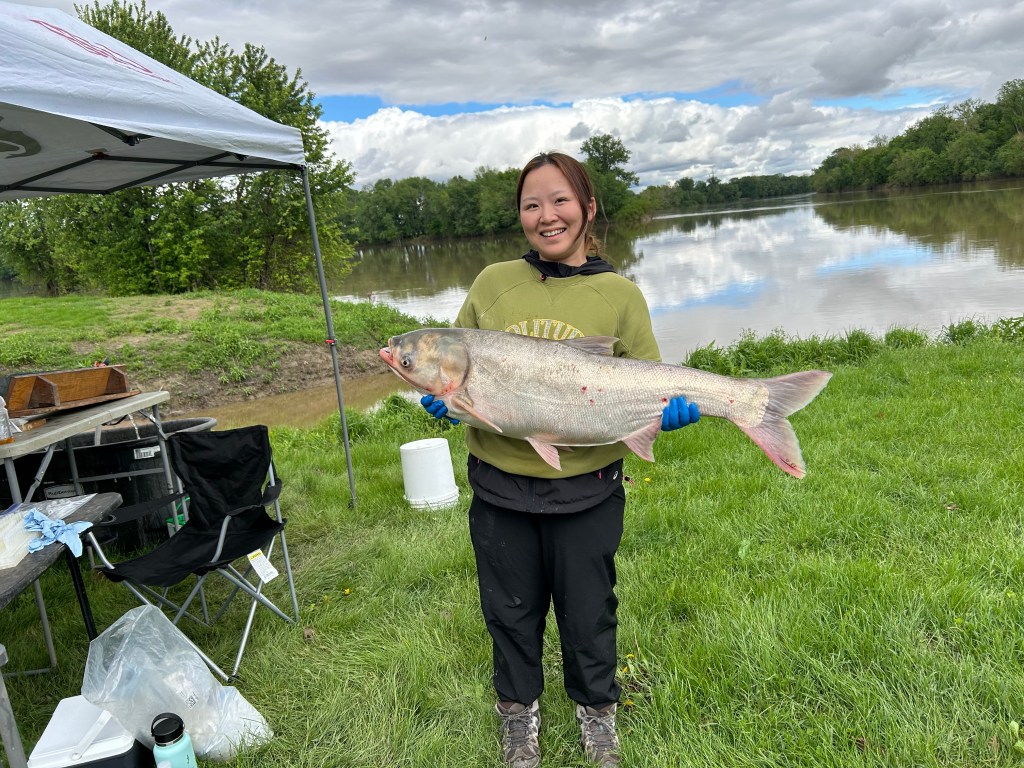
Through the use of passive acoustic telemetry, bigheaded carp movement strategies have been analyzed in the Illinois River and Lower Wabash River. Some bigheaded carp have been found to move up to 350 km, which is particularly alarming when some current management practices such as targeted harvest management revolve around individuals aggregating. Suppressing bigheaded carp through targeted harvest is a common management practice conducted to prevent their dispersal into the Great Lakes. Within the Illinois River, more and more bigheaded carp are being harvested each year, creating the concern of whether it does effectively reduce the population. CFAAS evaluated harvest management response plans within the Grayville oxbow of the Wabash River using hydroacoustics in March 2023. Harvest reduced invasive carp densities from 0.25 individuals per 1000m2 to 0.04 individuals per 1000m2.
Researchers at CFAAS have worked hard to prevent the dispersal of bigheaded carp by conducting research that allows us to better understand the movement and dispersal potential of bigheaded carp which is essential to effectively survey, prevent, and manage these invasive species.
If you have questions about this project, please contact us at 618-536-7766. More information about the Center can be found at http://fisheries.siu.edu.
 Trophic Ecology